
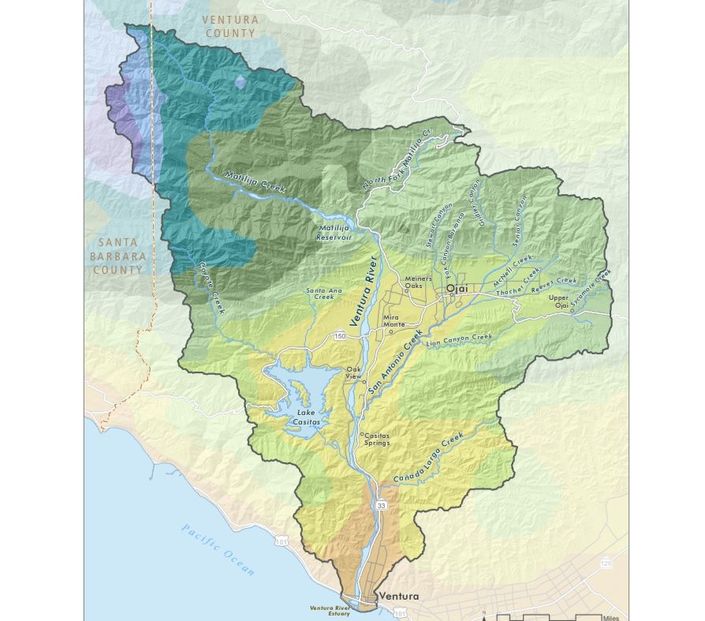
Sponge Valley In-Person Workshop in Ojai, California, Sunday, November 15th
How Ojai can soak up the rain, and grow resilience to drought, fire, floods, and heat through the soil sponge and living climate
Enroll in Course
Sponge Valley: How Ojai can Soak Up the Rain, and Grow Resilience to Drought, Fire, Floods, and Heat through the Soil Sponge and Living Climate
Half-day workshop at The Village Archive in Ojai, CA
Sunday, November 15th, 1-5PM
(followed by dinner and conversation at the Farmer and the Cook)
Join us for a live, in-person workshop introducing the multiple interrelated benefits that would flow if the Ventura River Watershed focused on becoming a "Sponge Valley" and activating the small water cycle. This understanding is particularly important as we face what is potentially the most intense El Niño in history.
Learn how to dramatically reduce the risk and impact of flooding, fire, heatwaves, and drought…by working with (not against) nature's own processes. When a landscape is fully functional, water is captured uphill, and across whole landscapes, (not just in dams and ponds.) This changes everything, including local temperatures and rainfall. We can do this in a number of innovative ways. We can kickstart it using process-based restoration like check dams, ponds, beaver restoration, and gully stuffing. But we can also work at a landscape scale through grazing and agricultural management, and urban rain capture. Healthy soil with biologically diverse vegetation can regain the structural and functional integrity of a sponge, and can soak up rain and store water everywhere.
The workshop is sponsored by The Ojai Fire Safe Council, The Village Archive, Rehydrate California, and Project TMRW. It is a very affordable short version of Didi Pershouse's five-week foundation course (which will be offered online in January/February 2027). Please invite others who you think would benefit from a whole-systems view of water, weather and resilience in the Ventura River Watershed.
Whether you are a farmer, rancher, policy maker, journalist, educator, or community organizer, you will see the potential of simple strategic land-management decisions to create the conditions for land to naturally regenerate its spongy structure, and make way for plants, animals, and soil microbes to improve the health and resilience of the entire region.
Communities that create conditions for a soil sponge and living climate to grow experience interrelated benefits such as:
- Healthier crops, animals, and people
- Resilience to flood and drought
- Abundant clean water
- Cooler regional temperatures
- Reduction of wildfire risk
- Reduced erosion, dredging, and road repairs'
- Higher farm profitability
- Prevention of algae blooms and dead zones
- Cleaner air
- Increased biodiversity
- Improved local economies
- Putting atmospheric carbon to work creating landscapes that support all of life
Your Instructor
Didi Pershouse is well known as an innovative international educator both in-person and online. She is the founder of the Land and Leadership Initiative. Her facilitator's guide Understanding Soil Health and Watershed Function is used in over 90 countries.
She became deeply involved in the intersection of food systems and health systems while providing rural health care for two decades at The Center for Sustainable Medicine, and wrote The Ecology of Care: Medicine, Agriculture, Money, and the Quiet Power of Human and Microbial Communities.
She has written a field training manual for the UN-FAO Farmer Field School Program and the Andhra Pradesh Community Managed Natural Farming Initiative in India, involving over 1,000,000 smallholder farmers. She was a contributing author to The Climate Emergency: How Africa Can Survive and Thrive; Climate Change and Creation Care; and Health in the Anthropocene. She was one of five speakers at the United Nations-FAO World Soil Day in 2017.
She serves on the Planning Commission for her town, is a board supervisor for the White River Natural Resources Conservation District, and is on the board of directors of Regenerate Earth, Soil Carbon Coalition and the Vermont Healthy Soils Coalition. While serving on the state appointed Payment for Ecosystem Services and Soil Health Working Group, she helped to reorient the program back to its public roots. She led a successful effort to conserve the Zebedee Headwaters Wetland while serving as a Vermont Conservation Commissioner.
She is on the Vision Council of the Global Earth Repair Convergence, and a member of the Ecosystem Restoration Alliance. She is a lineage member of the Change Agent Development Community (stewarded by Carol Sanford), and is seeding new communities of practice in a Wisdom tradition that uses living systems thinking.