
Designing Regenerative Systems
Scaling Land Management Across Urban, Rural, and Wild Landscapes, with Warren Karlenzig
Enroll in Course
Designing Regenerative Systems:
Scaling Land Management Across Urban, Rural, and Wild Landscapes
with author Warren Karlenzig, hosted by Didi Pershouse
Postponed, (rescheduled to Wednesday, October 21)
9 - 11 AM Pacific (Noon to 2 pm Eastern)
Are you wondering when we are going to start putting regenerative ideas into practice? Let's look at where it is already happening, and how to make it work where you are.
This workshop translates Warren Karlenzig’s global experience into an actionable, multi-landscape design framework—from planning natural system urban water solutions in Beijing's original Sponge City pilot and Los Angeles's ongoing aquifer recharge, to Slovenia’s national regenerative model (Regen Nation), down to community-scale projects in Marin County.
Core Focus: Our working discussion shifts the regenerative focus away from individual sectors - such as agriculture - and concentrates on active regeneration across the entire land-use continuum: urban cores, suburban interfaces, forests, grasslands, wetlands, working rangelands, and small-scale farms.
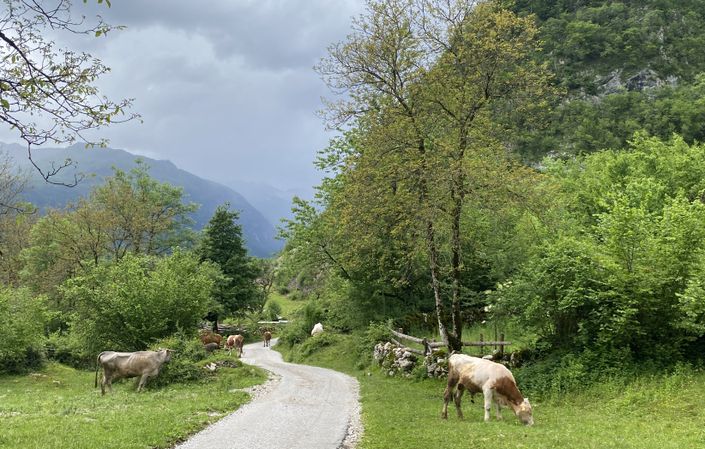
Case Study of Slovenia: We will look closely at Karlenzig's multi-year research project - Regen Nation - exploring how the EU nation of Slovenia provides a deeply inspiring national holistic regenerative model based on policies, projects, and practices. These include land-use management, local food, outdoor education, and societal equity. Slovenia’s citizens enjoy free access to education (pre-K through the university level), universal health care, and unrestricted recreational and foraging access to virtually all land, private and public.
Using biodiversity (and rewilding) as a key indicator, Slovenia’s policy keystone and cultural touchstone is successive forestry. Forty percent of land has protected status. The Slovenian approach to forestry is rapidly being adopted throughout the European Union through the organization Pro Silva.
Warren Karlenzig (www.commoncurrent.com) has devoted his career to designing and effecting large-scale system change in urban areas and in regional land-use management for ecological, economic, and cultural impact. He has successfully developed policies and supportive land/ surface water management pilot projects on behalf of metro areas, including Beijing (Sponge City Pilot) and Los Angeles (Los Angeles Dept. Water and Power aquifer recharge pilot).
He has worked for or partnered with the United Nations, Autodesk, Aclima, and Google Earth, as well as NGOs, foundations, and national research laboratories in the US, China, and the EU. He is the author of How Green Is Your City? (2007: Foreword by Paul Hawken), which benchmarked and defined sustainability in 50 US cities, Warren has lectured at Stanford, UC Berkeley, the Vienna Technikum and Seoul National University.
Warren and his life partner tend their small organic fruit orchard in California’s Marin County, where he has created community-scale green infrastructure projects.
Didi Pershouse is well known as an innovative international educator both in-person and online. She is the founder of the Land and Leadership Initiative. Her facilitator's guide Understanding Soil Health and Watershed Function is used in over 90 countries.
She became deeply involved in the intersection of food systems and health systems while providing rural health care for two decades at The Center for Sustainable Medicine, and wrote The Ecology of Care: Medicine, Agriculture, Money, and the Quiet Power of Human and Microbial Communities. She has written a field training manual for the UN-FAO Farmer Field School Program and the Andhra Pradesh Community Managed Natural Farming Initiative in India, involving over 1,000,000 smallholder farmers. She was a contributing author to The Climate Emergency: How Africa Can Survive and Thrive; Climate Change and Creation Care; and Health in the Anthropocene. She was one of five speakers at the United Nations-FAO World Soil Day in 2017.
She serves on the Planning Commission for her town, is a board supervisor for the White River Natural Resources Conservation District, and is on the board of directors of Regenerate Earth, Soil Carbon Coalition and the Vermont Healthy Soils Coalition. While serving on the state appointed Payment for Ecosystem Services and Soil Health Working Group, she helped to reorient the program back to its public roots. She led a successful effort to conserve the Zebedee Headwaters Wetland while serving as a Vermont Conservation Commissioner.
She is on the Vision Council of the Global Earth Repair Convergence, and a member of the Ecosystem Restoration Alliance. She is a lineage member of the Change Agent Development Community (stewarded by the late Carol Sanford), and is now seeding new communities of practice in a Wisdom tradition that uses living systems thinking.